Art Beyond the Gallery: Why Visual Communication Matters
Nov 21, 2026
Dek for the blog index: Why visual communication matters, and why you already speak the language.
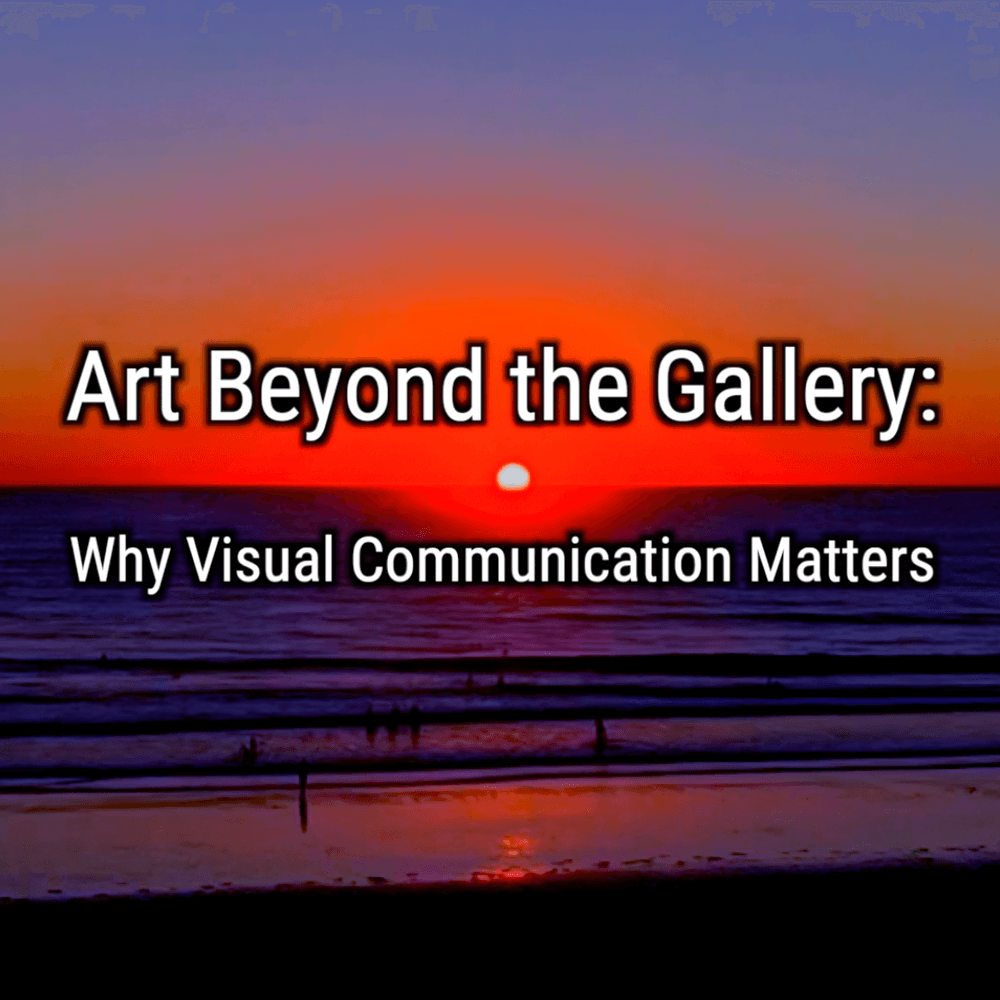
Stand on any San Diego beach at sunset and watch what happens. Conversations pause. Phones come out. Strangers end up looking at the same sky together. Nobody announces it, and nobody needs to. The sky is doing the talking.
That, to me, is visual communication. I am a Deaf artist, and my first language is a visual one, so people sometimes assume this subject belongs to me uniquely. I see it differently. Visual communication belongs to everyone. This post is about why it matters, and I will use some of my own paintings along the way as examples.
A language everyone already speaks
Color, shape, movement, and expression are how meaning travels when words stay out of it.
A red evening sky means something. So does a wave standing up to break, or a friend's face across a crowded room, telling you how their week went before you are close enough to ask. None of it needs translation, in any country, at any age. A baby reads faces months before understanding a single word. Visual communication is the first language all of us learned, and we never stop being fluent in it.
My paintings try to work in that language. When I paint a sky in flat bands of orange, pink, and blue, I am not describing a sunset. I am trying to hand you the feeling of one, directly, with nothing standing in between.
What a signed language adds
American Sign Language lives entirely in that visual world. It is built from movement, rhythm, and expression, with the hands, the face, and the space in front of the body all working at once. In ASL, where you place something matters, and so does how fast or slow you sign it. A pause can be a whole sentence.
That rhythm finds its way into the artwork. The stripes in my skies are a kind of phrasing, band after band, the way a signed sentence moves. I paint palm trees as bold, dark silhouettes because in a visual language a clear shape carries. It should read from across the room, the way a clear handshape does. And when I paint the same palm across a row of panels with the sun in a different position in each one, that is time made visible, morning on the left and evening on the right. In ASL, time is something you can point to. I like putting it where everyone can see it.
Nature said it first
San Diego taught me most of what I know about color. On a clear evening the sky over the Pacific separates into bands of orange resting on pink resting on blue. I did not invent that. I just kept watching it, year after year, until it became the way I paint.
Nature communicates visually all day long. Light tells you the hour. Color tells you the season and the weather. The ocean repeats one patient gesture from morning to night, and the palms lean and recover in the wind like hands keeping rhythm. Nobody taught us to read any of this, and yet everyone on that beach at sunset is reading it together.
So when people tell me my colors feel like California, I take it as a good sign. It means I watched carefully enough. Whatever atmosphere the paintings have is borrowed, with gratitude, from the place itself.
Art beyond the gallery walls
A gallery is one home for art. It was never the only one.
Lately I have been making short videos of the paintings, cut to a visual rhythm and built to be understood with the sound off. Film is painting with time inside it, and it travels to people who may never walk into a gallery at all.
Then there is the quietest life a painting can have: someone's hallway. A piece hangs where a person drinks their coffee every morning, and it keeps communicating, a small daily conversation that no longer needs me at all. Art in public spaces works the same way. You round a corner and color meets you at full scale, unplanned. And some of it costs nothing and hangs nowhere. Noticing the light on your own street is an artistic act too.
Art lives wherever eyes do.
Why visual communication matters
Because it connects people that words sometimes cannot. Deaf and hearing. A grandmother and a grandchild standing in front of the same painting with sixty years between them, each reading it their own way, and both of them right.
And because art, at its best, changes how people see after they walk away from it. If one of my striped skies makes you look twice at the real sky on your drive home, then the painting did its job, and the gallery walls had nothing to do with it.
You already speak this language. The paintings are just reminders.
Thank you for looking.